
Interventional radiology billing relies on component coding—billing the procedural intervention separately from the imaging supervision and interpretation (S&I)—a framework requiring precise application of modifiers, catheter hierarchy rules, and imaging guidance codes to maximize compliant reimbursement. VeriMedix ensures your IR claims are coded completely and paid correctly.
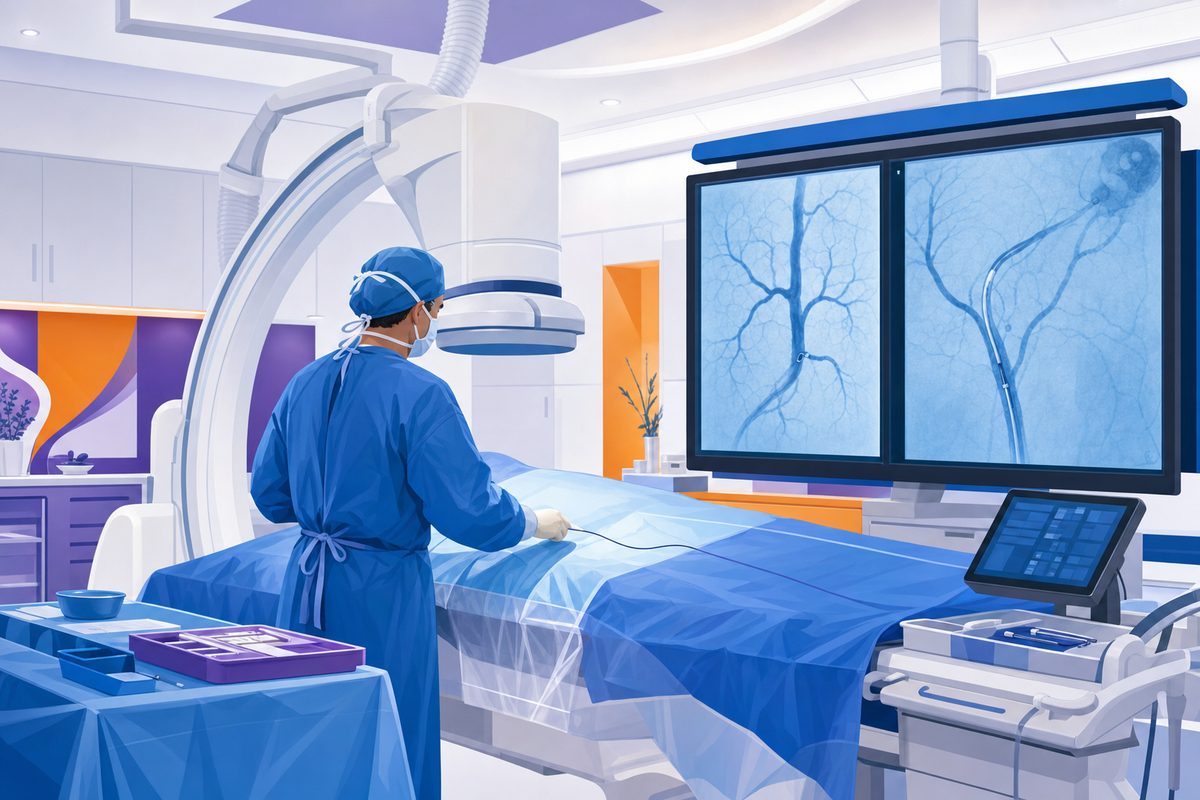
Interventional radiology (IR) operates on a component coding model: the procedural intervention (e.g., catheter placement, stent deployment, embolization) is billed with a surgical CPT code, and the imaging guidance used to perform it (fluoroscopy, ultrasound, CT) is billed separately using imaging supervision and interpretation (S&I) codes. For example, a percutaneous drainage procedure bills both the drainage CPT (e.g., 49405 for visceral/soft tissue) and the imaging guidance (75989 or 76942). When the IR physician both performs the procedure and interprets the imaging, the global code is used (no modifier). When an IR physician performs only interpretation without technical control of the equipment, modifier -26 applies.
Catheter placement procedures involve a hierarchy of coding based on the level of vessel selectivity. For vascular procedures, the Society of Interventional Radiology (SIR) and AMA define catheter placement levels: non-selective (aorta, main vessel branches), first-order selective, second-order selective, third-order selective. The highest order of selectivity achieved in each vascular territory (e.g., right and left femoral systems are separate vascular families) determines the catheter placement code. Operators must document catheter advancement through each vessel to support the code assigned. Bundling rules prevent billing both the catheter placement and the diagnostic angiogram in the same vessel when the angiogram is integral to the interventional procedure.
Place of service and technical component billing in IR require careful attention. IR procedures may be performed in a hospital inpatient setting (POS 21), hospital outpatient/HOPD (POS 22), ASC (POS 24), or in an office-based lab (OBL, POS 11). In the hospital or HOPD, the facility bills the technical component while the IR physician bills the professional component (-26). In an OBL owned by the IR group, the practice may bill the global code (technical + professional) for significantly higher reimbursement, making OBL financial modeling a key revenue strategy. However, OBL operations require significant compliance infrastructure including equipment, CLIA/state licensure, and payer-specific coverage policies.
Below are commonly billed codes our certified coders manage for interventional radiology practices. Always confirm payer-specific coverage and current code values.
| Code | Description | Billing note |
|---|---|---|
36245 | Selective catheter placement, arterial system; each first order branch within an abdominal, pelvic, or thoracic vascular territory | Vascular catheter hierarchy; document vessel selectivity in the procedure note; one code per vascular territory |
36247 | Selective catheter placement, arterial system; initial third order or more selective thoracic or abdominopelvic branch | Highest-order catheterization within a vascular family; document each vessel catheterized with fluoroscopic images |
49405 | Image-guided fluid collection drainage by catheter; visceral (e.g., abdominal, pelvic) or thoracic (excluding lung/pleural) | Component coding: bill 49405 + imaging guidance (76942/75989) separately; document catheter size and final position |
75710 | Angiography, extremity, unilateral, radiological supervision and interpretation | S&I code; bill with -26 in hospital setting; global in OBL setting; pair with appropriate catheter placement code |
37243 | Vascular embolization or occlusion, inclusive of all radiological supervision and interpretation, intraprocedural roadmapping and final angiographic assessment; for tumors, organ ischemia, or infarction | Embolization code inclusive of S&I—do not separately bill imaging guidance; document target vessel and embolic agent |
47000 | Biopsy of liver, needle; percutaneous | Paired with imaging guidance (76942 ultrasound or 77012 CT); document imaging guidance modality used |
37221 | Revascularization, endovascular, iliac artery; stent placement (includes angioplasty within same vessel when performed) | Inclusive of angioplasty within same segment; do not separately bill 37220 (angioplasty) for same vessel |
36830 | Creation of arteriovenous fistula; nonautogenous graft | Dialysis access creation; 90-day global; common in IR/vascular; document AV graft vs. fistula (36821 autogenous) |
Our standard operating procedures for interventional radiology revenue cycle management — the step-by-step workflow we follow on every claim:
These are the issues we see most often in interventional radiology billing — and exactly how we resolve them:
IR practices frequently perform and document imaging guidance but fail to code it separately (when separately payable). Fix: implement a charge capture checklist for each procedure type listing all billable components; tie the checklist to the procedure note template so coders can verify each element was performed and documented.
Billing third-order selective catheterization (36247) without a procedure note that documents each vessel catheterized invites audit denial and recoupment. Fix: require that the procedure note list each vessel navigated with angiographic confirmation; use standardized IR report templates that include vessel-level catheterization documentation.
When a diagnostic angiogram is performed in the same vessel as the intervention (e.g., renal angioplasty with pre-procedure renal angiogram), the diagnostic angiogram is generally bundled into the interventional code. Billing separately triggers NCCI denial. Fix: only bill the diagnostic angiogram separately when it was performed as an independent study with distinct clinical indication (apply -59 and document the separate rationale).
IR physicians performing procedures in hospital outpatient facilities must apply modifier -26 to imaging codes or risk the claim being rejected as a duplicate of the facility's technical component claim. Fix: configure your billing system to auto-apply -26 to all imaging guidance and S&I codes when POS is 21 or 22.
Office-based labs that bill global IR codes face intense payer scrutiny. Missing state licensure, inadequate documentation of equipment calibration, or absent quality assurance programs trigger audits and recoupment. Fix: maintain an OBL compliance calendar tracking state licensure renewals, equipment service logs, and payer credentialing status for the facility.
Verimedix works inside the systems interventional radiology practices already use, including:
Component coding means billing the procedural intervention and the imaging supervision and interpretation (S&I) as separate CPT codes. For example, a liver biopsy bills the biopsy code (47000) plus an imaging guidance code (76942 for ultrasound or 77012 for CT). Some codes (like embolization 37241–37244) are all-inclusive and do not allow separate S&I billing.
Catheter placement is coded by the level of selectivity: non-selective (36200 for aorta), first-order selective (36245), second-order (36246), third-order (36247). You code the highest level achieved in each vascular territory (family). The right and left sides of paired vessels like renal or iliac arteries are separate vascular families, allowing separate catheter codes for each side.
A diagnostic angiogram can be billed separately when: (1) the pre-procedure diagnosis was uncertain and a diagnostic angiogram was required to determine whether intervention was indicated, or (2) the diagnostic study provided information beyond roadmapping for the intervention. Document the medical necessity for the separate diagnostic study; apply modifier -59 or -XU to the angiography code.
An OBL is an IR procedure suite located outside the hospital setting and owned by the physician practice. When the practice owns the equipment and performs procedures in the OBL, they may bill the global code (professional + technical components combined) for significantly higher reimbursement than hospital-based -26 professional billing. OBLs require state licensure, payer contracting for the facility, and compliance with CMS conditions.
Yes, many IR procedures are on the ASC covered procedure list (e.g., vascular access, dialysis interventions, certain embolizations). The ASC bills the facility fee while the IR physician bills the professional component (-26). Not all payers cover all IR procedures in the ASC—verify coverage by procedure and payer before scheduling.
Tunneled central venous catheter insertion is billed with CPT 36558 (non-cuffed) or 36560 (cuffed, with port) plus imaging guidance (76937 for ultrasound vein mapping, 77001 for fluoroscopic guidance). In a hospital setting, apply -26 to imaging codes. The catheter and supplies are separately billable under HCPCS codes for device pass-through if applicable.
Verimedix handles the entire interventional radiology revenue cycle — coding, submission, denials, and A/R — so your team can focus on patients.