
Nephrology billing is uniquely structured around Medicare's ESRD monthly capitation payment (MCP) system, which bundles all dialysis-related services into a per-patient-per-month payment—requiring precise patient count tracking, face-to-face visit documentation, and AV access coding to capture the full value of every case. VeriMedix ensures your nephrology practice optimizes every component of ESRD and CKD billing.
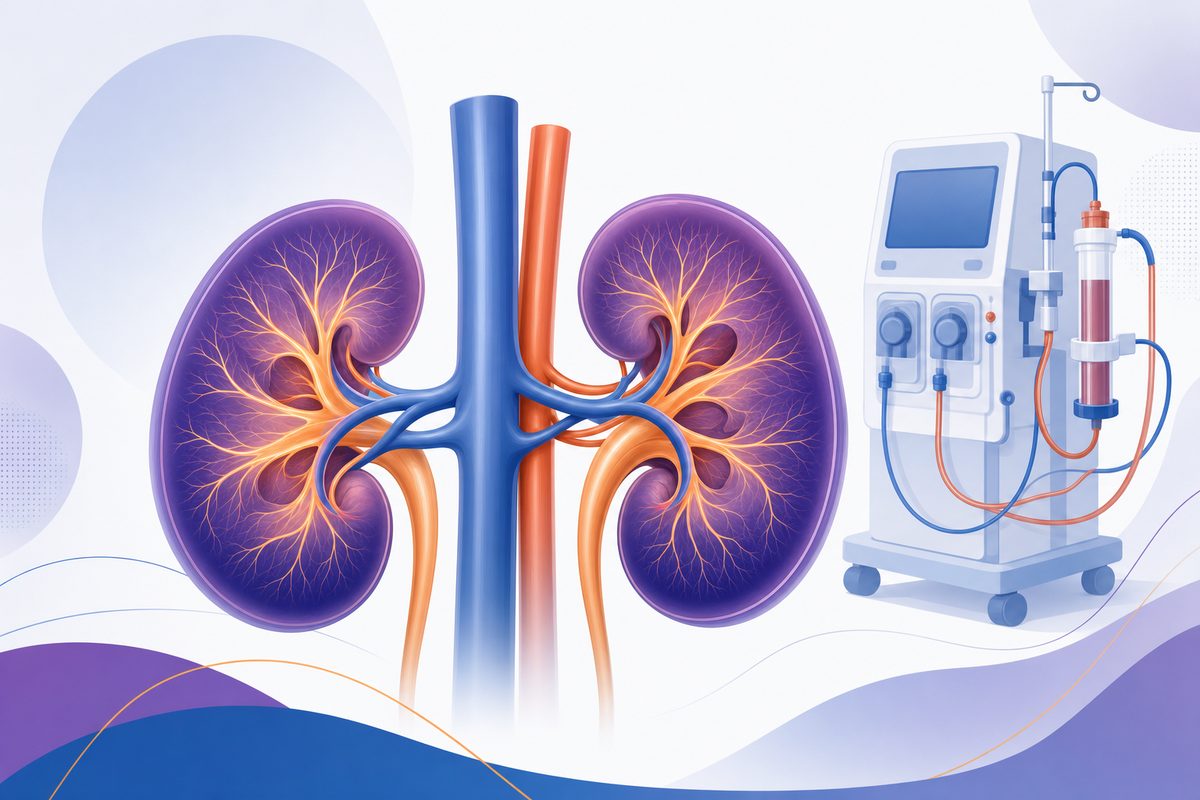
Nephrology billing divides into two distinct segments: end-stage renal disease (ESRD) patients on dialysis, and pre-dialysis chronic kidney disease (CKD) management. For ESRD patients, Medicare reimburses the nephrologist through the Monthly Capitation Payment (MCP) system—a per-patient-per-month bundled payment that covers all dialysis-related evaluation and management services. The MCP rate is tiered by the number of face-to-face patient visits performed during the month: four or more visits per month yields the full MCP rate (CPT 90960–90966 for outpatient dialysis; 90967–90970 for inpatient/hospital-based), with reduced rates for fewer visits. The practice's per-month revenue for the ESRD population depends directly on documented visit counts, making visit tracking a critical billing function.
The MCP bundle (ESRD monthly capitation codes 90951–90970) covers E/M services related to ESRD but does NOT include separately billable services for unrelated conditions, procedures on the dialysis access (AV fistula, graft, or catheter), kidney transplant evaluation, or acute hospitalizations. Separately billable services commonly performed by nephrologists include: AV fistula creation and repair (36821, 36830), tunneled dialysis catheter placement and removal (36558, 36596), parathyroidectomy evaluation, and kidney biopsy (50200). These must be billed with correct procedure codes outside the MCP bundle. Knowing what is inside versus outside the MCP bundle is the foundational billing knowledge in nephrology.
CKD management (pre-dialysis) follows standard E/M billing rules (99213–99215 for office visits) with appropriate ICD-10 specificity for CKD stage (N18.1–N18.6, N18.9). CKD coding requires the nephrologist to document both the CKD stage and any associated conditions (hypertensive CKD: I12.x, I13.x; diabetic CKD: E11.65 or E13.65). Transplant patient management post-transplant uses CPT codes 90963–90966 for ESRD patients with a functioning transplant receiving ongoing dialysis, and standard E/M for transplant follow-up when dialysis is no longer needed. Anemia management in CKD/ESRD (EPO injections: J0885, J0886; iron infusion: 96365 + J1756) adds another billable service stream requiring specific documentation of hemoglobin levels and treatment decisions.
Below are commonly billed codes our certified coders manage for nephrology practices. Always confirm payer-specific coverage and current code values.
| Code | Description | Billing note |
|---|---|---|
90960 | End-stage renal disease (ESRD) related services monthly, for patients younger than 2 years of age; with 4 or more face-to-face visits per month | Full MCP payment for pediatric ESRD; adult equivalent: 90963 (home dialysis) or 90966 (outpatient dialysis); 4+ visits required for full rate |
90966 | ESRD-related services monthly, for patients 20 years of age and older; with 2–3 face-to-face visits per month | Reduced MCP rate for 2–3 monthly visits; 90965 = 1 visit/month; 90963 = 4+ visits/month for patients 20+ |
90963 | ESRD-related services monthly, for patients 20 years of age and older; with 4 or more face-to-face visits per month | Full MCP rate for adult outpatient ESRD; bill monthly; document visit dates and face-to-face nature |
90967 | ESRD-related services for dialysis occurring in a hospital inpatient or skilled nursing facility per day; patients younger than 2 years of age | Per-diem inpatient ESRD code; adult equivalent 90970 (patients 20+); billed daily during inpatient dialysis |
90970 | ESRD-related services for dialysis occurring in a hospital inpatient or SNF per day; patients 20 years of age and older | Per-day inpatient/SNF ESRD management; replaces monthly code during hospital admission |
50200 | Renal biopsy; percutaneous, by trocar or needle | Kidney biopsy for CKD workup; billed outside MCP bundle; requires imaging guidance code (76942 or 77012) separately |
36821 | Arteriovenous anastomosis, open; direct, any site (AV fistula creation) | Dialysis access creation; 90-day global; outside MCP bundle; commonly billed by nephrologists or vascular surgeons |
J0885 | Injection, epoetin alfa (HCPCS drug code); for ESRD on dialysis, per 1000 units | EPO injection for anemia management in ESRD; document hemoglobin levels; subject to ESRD PPS bundling for facility |
99213 | Office or other outpatient visit, established patient, moderate complexity (E/M) | Used for CKD management (pre-dialysis) and unrelated conditions in ESRD patients outside the MCP bundle; requires ICD-10 specificity |
Our standard operating procedures for nephrology revenue cycle management — the step-by-step workflow we follow on every claim:
These are the issues we see most often in nephrology billing — and exactly how we resolve them:
Nephrologists performing 4 or more dialysis patient visits per month but documenting only 2–3 in the medical record are reimbursed at the lower tier (90966 vs. 90963). Fix: implement a dialysis visit log or tracker that clinicians update at point of care; reconcile against billing at month end before claim submission.
Services included in the MCP (E/M related to dialysis management, minor complications of dialysis) cannot be billed separately. Billing separately results in denial and recoupment. Fix: maintain an up-to-date list of services included in the MCP bundle versus separately billable; train billing staff and providers on what falls outside the bundle.
When an ESRD patient is admitted to the hospital, the monthly outpatient MCP code must be replaced with the per-day inpatient code (90970) for the days of hospitalization. Billing the monthly code (90963) for a month with a hospital stay is an overpayment. Fix: build a hospital admission alert into your patient management system that triggers the billing department to switch to 90970 daily coding.
CKD claims submitted with N18.9 (unspecified CKD) rather than N18.3/N18.4/N18.5 (staged CKD) fail risk adjustment scoring and may trigger medical review. Fix: require CKD stage documentation at every nephrology encounter; configure your EHR's problem list to prompt for CKD stage update annually.
If an ESRD patient dies or receives a kidney transplant mid-month, the MCP code must be prorated or the monthly claim must not be submitted for a full month. Fix: implement a monthly census reconciliation step that verifies the status (active on dialysis, transplanted, deceased) of every patient in the ESRD billing file before month-end submission.
Verimedix works inside the systems nephrology practices already use, including:
The MCP is a monthly lump-sum payment Medicare makes to the nephrologist for managing all ESRD-related services for a dialysis patient. The payment amount depends on the number of face-to-face visits during the month: 4 or more visits/month yields the highest tier (CPT 90963 for outpatient adults); 2–3 visits yields a lower tier (90966); 1 visit is 90965. Inpatient dialysis management is billed per day with 90970.
Services separately billable outside the MCP include: AV fistula and graft creation/revision, dialysis catheter placement and removal, renal biopsy, kidney transplant evaluation, management of conditions completely unrelated to ESRD (with -25 modifier and separate documentation), and certain high-cost drugs when administered in the physician's office (EPO, iron infusion).
CKD stages are coded as: N18.1 (Stage 1), N18.2 (Stage 2), N18.3 (Stage 3a), N18.31 (Stage 3a), N18.32 (Stage 3b), N18.4 (Stage 4), N18.5 (Stage 5), N18.6 (ESRD). When CKD is due to hypertension, use I12.9 (hypertensive CKD, unspecified stage) with the N18.x code. When due to diabetes, use E11.65 (Type 2 DM with diabetic CKD) with the N18.x code.
Generally no, for ESRD-related problems—the E/M is bundled into the MCP. However, if the patient is seen for a condition completely unrelated to their ESRD (e.g., a new rash, a URI), that visit may be separately billed with modifier -25 and documentation that clearly establishes the separate, unrelated nature of the visit.
Erythropoiesis-stimulating agents (ESAs) and iron infusions administered in the physician office (not the dialysis facility) are billed using HCPCS drug codes: J0885 (epoetin alfa, per 1000 units) and J1756 (iron sucrose, per 1 mg). The administration is billed with 96365 (IV infusion, initial). Document the hemoglobin level, dose ordered, and clinical indication for treatment in the record.
After a successful kidney transplant, if the patient no longer requires dialysis, ESRD monthly dialysis codes no longer apply. Post-transplant management is billed with standard E/M codes. If the transplant fails and dialysis resumes, ESRD billing resumes. The MCP claim for the month of transplant must be prorated for the days before transplant; do not submit a full-month MCP for the transplant month.
Verimedix handles the entire nephrology revenue cycle — coding, submission, denials, and A/R — so your team can focus on patients.