
Neurosurgery billing is among the most technically demanding in medicine—complex procedure codes, 90-day global periods, co-surgeon arrangements, implant billing, and strict prior authorization requirements create a revenue cycle that demands expert management. VeriMedix provides the specialty-trained billing support neurosurgical practices need to get paid accurately and on time.
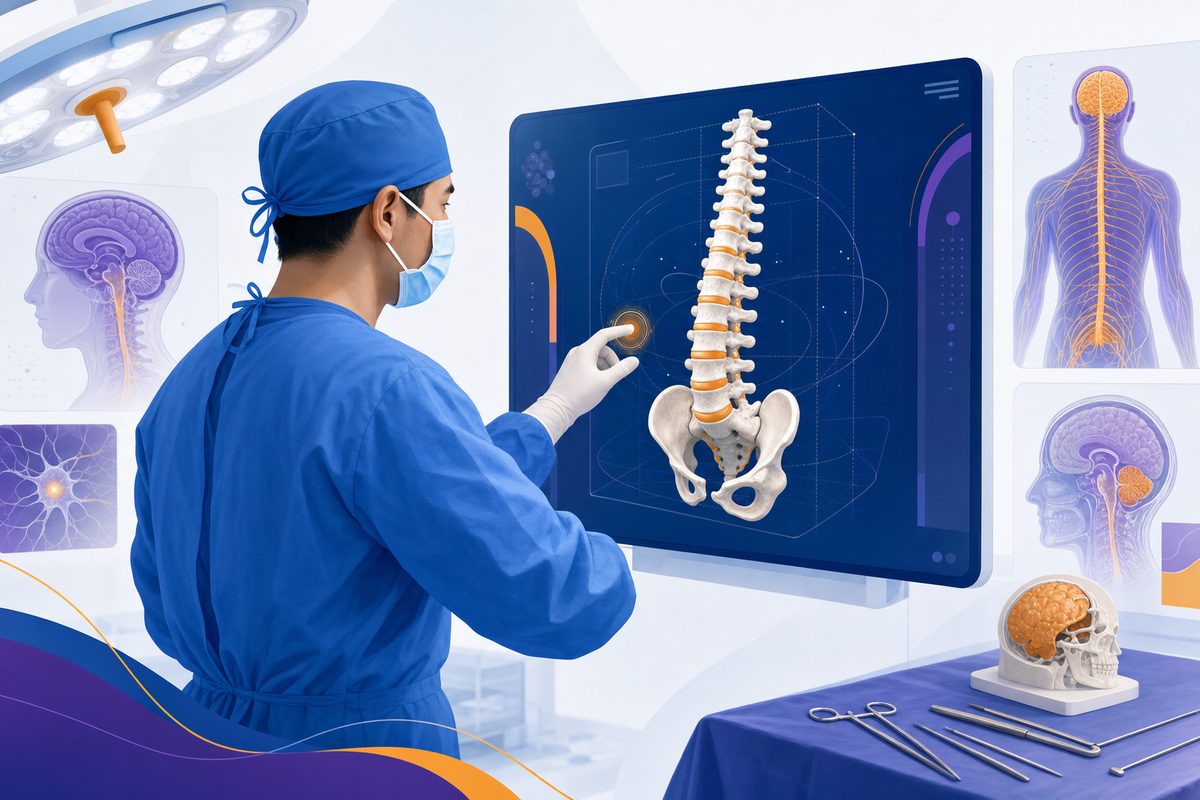
Neurosurgery billing encompasses three primary procedure categories: intracranial surgery (CPT 61000–61888), spinal surgery (CPT 62000–63748), and peripheral nerve procedures (CPT 64400–64999). Each procedure is associated with a global surgical package—the bundled payment that covers the surgery itself, preoperative evaluation on the day before surgery, and all routine postoperative follow-up care within the global period (90 days for major procedures, 10 days for minor). During the global period, the operating neurosurgeon cannot bill separately for related E/M visits or services unless the patient presents with an unrelated condition (modifier -24), a new problem requiring a separate decision for surgery (modifier -57), or a staged procedure (modifier -58). Understanding and correctly applying global period rules is the single most important compliance and revenue consideration in neurosurgery billing.
Co-surgeon billing (modifier -62) applies when two surgeons of different specialties each perform a distinct portion of the same procedure—for example, a neurosurgeon performing the posterior spine fusion while a vascular surgeon manages the anterior approach. Each co-surgeon bills the same CPT code with modifier -62 and submits a separate operative report documenting their distinct contribution. Medicare reimburses each co-surgeon at 62.5% of the allowable fee schedule amount for the procedure. Assistant surgeon modifiers (-80 for physician assistant surgeon, -82 when a qualified resident is unavailable, -AS for non-physician assistants) are used when one provider assists another; assistant surgeon reimbursement is typically 16% (Medicare) or 20% (commercial) of the primary procedure allowable. CMS uses a fee schedule status indicator to determine whether assistant surgeons are payable for each procedure code—indicators '1' and '9' prohibit assistant surgeon billing.
Neurosurgery has one of the highest claim denial rates of any specialty—industry estimates cite rates of 15–18% or higher. Leading causes include missing prior authorization (particularly for elective spine and intracranial procedures), incorrect spinal level coding, failure to report add-on codes for additional spinal levels or interbody cages, implant billing errors (hardware billed to the wrong payer or at invoice vs. cost), and diagnosis-procedure mismatches where the ICD-10 codes do not clearly establish medical necessity for the procedure performed. Documentation requirements are extensive: the operative report must detail every step of the procedure, the number of spinal levels operated on, the type and size of any implants, and the specific techniques used. A missing or incomplete op note is the fastest route to a denied or audit-flagged claim.
Below are commonly billed codes our certified coders manage for neurosurgery practices. Always confirm payer-specific coverage and current code values.
| Code | Description | Billing note |
|---|---|---|
63047 | Laminectomy, facetectomy and foraminotomy, single vertebral segment; lumbar | Most common lumbar decompression code; document the specific level(s) and structures addressed |
63048 | Laminectomy, facetectomy and foraminotomy, each additional segment (add-on to 63047) | Add-on code billed for each additional lumbar level; frequently missed, causing significant underbilling |
22612 | Arthrodesis, posterior or posterolateral technique, single level; lumbar | Posterior lumbar fusion; document graft type, instrumentation, and the specific spinal level |
22614 | Arthrodesis, posterior or posterolateral technique, each additional vertebral segment (add-on) | Add-on for each additional level of posterior fusion; must be billed for each level beyond the first |
61510 | Craniectomy, trephination, bone flap craniotomy; for excision of brain tumor, supratentorial, except meningioma | High-value craniotomy code; document tumor location (supratentorial), approach, and extent of resection |
63650 | Percutaneous implantation of neurostimulator electrode array; epidural | Spinal cord stimulator electrode placement; requires prior authorization and specific ICD-10 pain diagnoses |
22853 | Insertion of interbody biomechanical device(s) for anterior column stabilization (add-on) | Add-on for interbody cage or device; bill in addition to fusion code; document device type and level |
63030 | Laminotomy (hemilaminectomy), with decompression of nerve root(s), single interspace; lumbar | Lumbar disc herniation decompression; document the interspace, nerve root compressed, and disc level |
62270 | Spinal puncture, lumbar, diagnostic | Lumbar puncture; document indication, opening pressure, CSF studies ordered; frequently requires prior auth |
Our standard operating procedures for neurosurgery revenue cycle management — the step-by-step workflow we follow on every claim:
These are the issues we see most often in neurosurgery billing — and exactly how we resolve them:
Elective cranial and spinal procedures are among the most frequently denied for lack of prior authorization. Fix: Implement a mandatory pre-authorization check at scheduling for all elective neurosurgery procedures; do not schedule the procedure until authorization is confirmed; track expiration dates.
Surgeons operating on multiple levels bill only the primary code and omit add-on codes (e.g., 22614, 63048), leaving significant revenue uncaptured. Fix: Create a post-op charge capture workflow that cross-references the operative note level count against billed codes; require the coder to reconcile levels documented with levels billed.
Billing routine post-op follow-up E/M visits during the 90-day global period without the appropriate modifier causes claim denial. Fix: Flag all claims for the same patient within 90 days of a major procedure; require a modifier and documentation justifying separate billing for any E/M during the global period.
Modifier -62 is applied to procedure codes where CMS co-surgeon indicator is '1' (not payable), resulting in automatic denial. Fix: Check the CMS fee schedule co-surgery indicator for every procedure code before applying modifier -62; for indicator '0' codes, submit with supporting documentation of medical necessity.
Hardware billed at incorrect cost, billed to the wrong payer, or submitted with non-covered HCPCS codes leads to denials and overpayment recovery risks. Fix: Implement an implant tracking log tied to each surgical case; verify implant HCPCS codes against payer contract terms and CMS coverage policies before submitting.
Verimedix works inside the systems neurosurgery practices already use, including:
The 90-day global package includes: the preoperative visit on the day before surgery; the surgery itself and intraoperative services; immediate postoperative care in the recovery room; all routine follow-up E/M visits for the 90 days after the procedure related to the surgery; and treatment of minor complications not requiring a return to the OR. Services for unrelated conditions, complications requiring return to the OR, or new procedures can be billed separately with the appropriate modifier.
As of January 1, 2025, CMS requires modifier -54 (Surgical Care Only) whenever a surgeon performs a 90-day global procedure but does not intend to provide the postoperative care—whether or not there is a formal written transfer of care. The surgeon bills with modifier -54, receiving payment for the preoperative and intraoperative components only (approximately 80% of the global fee). The provider managing postoperative care bills with modifier -55.
Bill the primary procedure code for the first spinal level, then add the designated add-on code for each additional level. For example, a 3-level posterior lumbar fusion bills 22612 (first level) + 22614 (second level) + 22614 (third level). Each add-on code represents an additional vertebral segment. The operative report must explicitly identify each level operated on to support the number of add-on codes billed.
Modifier -62 (Co-surgeon) is used when two surgeons act as co-equal primary surgeons, each performing a distinct part of a single procedure. Both bill the same CPT code with -62 and receive approximately 62.5% of the allowable fee each. Modifier -80 (Assistant Surgeon) is used when one physician assists the primary surgeon who is solely performing the procedure. The assistant bills the same code with -80 and receives approximately 16% of the Medicare allowable (20% for commercial payers).
Yes, under specific coverage criteria. Spinal cord stimulator implantation (CPT 63650–63688) requires prior authorization and specific ICD-10 diagnosis codes for conditions like failed back surgery syndrome, complex regional pain syndrome, or intractable pain. Documentation must include failed conservative treatment, psychological screening, and a successful trial stimulation period (billed with a trial code) before permanent implantation.
Key ICD-10 codes include M51.16–M51.17 (intervertebral disc degeneration, lumbar/lumbosacral), M47.816 (spondylosis with radiculopathy, lumbar), G35 (multiple sclerosis), C71 series (malignant neoplasm of brain), I60–I67 (cerebrovascular disease), M48.062 (spinal stenosis, lumbar with neurogenic claudication), and S12–S14 series (spinal cord injuries). The ICD-10 code must directly support the medical necessity of the procedure—generic or unspecified codes increase denial risk.
Verimedix handles the entire neurosurgery revenue cycle — coding, submission, denials, and A/R — so your team can focus on patients.