
Pain management billing demands precise CPT code selection for spinal injections, nerve blocks, and ablation procedures—where imaging guidance is bundled into specific codes, bilateral procedures require specific modifiers, and frequency limits are strictly enforced. VeriMedix delivers the procedural coding accuracy and payer-rule expertise pain management practices need to sustain reimbursement and survive payer audits.
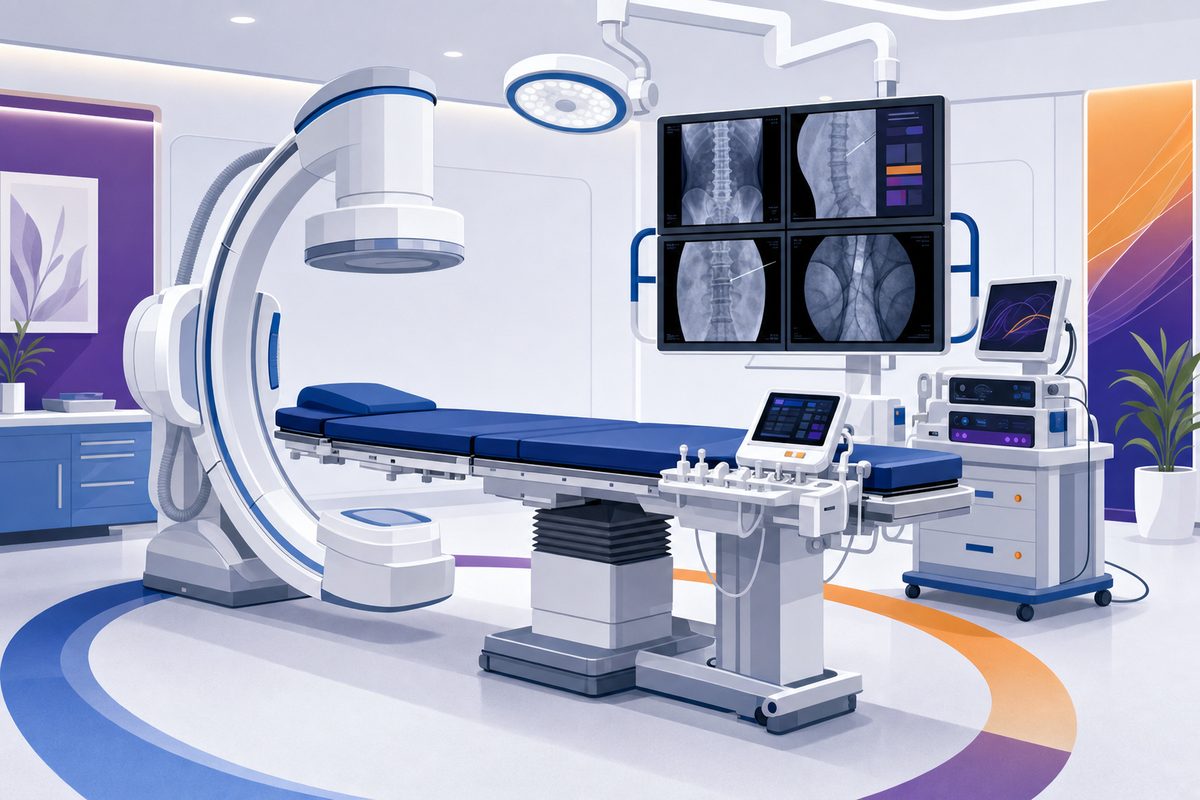
Pain management billing centers on interventional procedures: epidural steroid injections (ESIs), facet joint injections (FJIs), medial branch blocks (MBBs), radiofrequency ablation (RFA), and trigger point injections (TPIs). Each procedure family has distinct CPT codes that differentiate by anatomic region (cervical/thoracic vs. lumbar/sacral), approach (interlaminar vs. transforaminal for epidurals), and level (first level vs. additional level add-on codes). Fluoroscopic or CT guidance is bundled into transforaminal ESI codes (64479, 64480, 64483, 64484) and RFA codes (64633–64636)—billing 77003 alongside these codes is a NCCI bundling violation and a top denial cause. Interlaminar epidural codes 62321 and 62323 also include imaging when specified in their descriptors; verify bundling status before adding 77003.
Bilateral procedure billing in pain management requires careful modifier application. For transforaminal ESIs (64479, 64483) and RFA (64633, 64635) performed bilaterally, append modifier 50 for a single claim line, or use separate lines with RT and LT modifiers depending on the place of service and payer. In the ASC setting, modifier 50 is typically replaced with two separate lines using RT and LT. Most Medicare carriers and many commercial payers reimburse the contralateral side at a reduced rate (often 50% or 25% of the primary procedure fee). No bilateral modifier is appropriate for interlaminar ESI codes 62321 or 62323, as CMS has determined these are not bilateral procedures. Never combine modifier 50 with RT or LT on the same line—use one approach or the other.
Medicare enforces frequency limits on pain management procedures: no more than 4 epidural injection sessions (across all spinal regions) in a rolling 12-month period; facet injections and medial branch blocks are limited per region per year; RFA is typically reimbursable once per level per year. Prior authorization is required by an increasing number of commercial payers for epidurals, RFA, and spinal cord stimulator implantation. Documentation requirements are substantial: procedure notes must document the specific level(s) treated, approach, laterality, medications injected, fluoroscopic images stored, and the clinical indication. A mandatory conservative treatment trial (typically 6 weeks including PT and medications) is generally required before most interventional procedures will be authorized.
Below are commonly billed codes our certified coders manage for pain management practices. Always confirm payer-specific coverage and current code values.
| Code | Description | Billing note |
|---|---|---|
62321 | Injection(s), interlaminar epidural, cervical or thoracic; with imaging guidance (fluoroscopy or CT) | Not a bilateral procedure; imaging guidance bundled in; do not bill 77003 separately; one level per session |
62323 | Injection(s), interlaminar epidural, lumbar or sacral; with imaging guidance (fluoroscopy or CT) | Not a bilateral procedure; up to 4 total epidural sessions per year across all regions (Medicare) |
64483 | Injection(s), anesthetic agent and/or steroid, transforaminal epidural; lumbar or sacral, single level | Imaging guidance bundled; append RT or LT for unilateral; modifier 50 (or separate RT/LT lines) for bilateral; add 64484 for second level |
64484 | Injection(s), anesthetic agent and/or steroid, transforaminal epidural; lumbar or sacral, each additional level (add-on) | Maximum of 2 levels per session; bill with 64483 as primary code |
64490 | Injection(s), diagnostic or therapeutic agent, paravertebral facet (zygapophyseal) joint; cervical or thoracic, single level | Imaging guidance bundled; unilateral; add 64491 (second level), 64492 (third level) |
64493 | Injection(s), diagnostic or therapeutic agent, paravertebral facet (zygapophyseal) joint; lumbar or sacral, single level | Bundled imaging; add 64494 (second level), 64495 (third level); max 3 levels per session |
64635 | Destruction by neurolytic agent, paravertebral facet joint nerve(s); lumbar or sacral, single level | Radiofrequency ablation (RFA); imaging bundled; typically requires ≥50% pain relief on two prior diagnostic MBBs; add 64636 for additional levels |
64633 | Destruction by neurolytic agent, paravertebral facet joint nerve(s); cervical or thoracic, single level | Cervical/thoracic RFA; imaging bundled; add 64634 for additional levels; once per level per year |
20553 | Injection(s); single or multiple trigger point(s), 3 or more muscles | No more than 3 TPI sessions considered medically necessary per year per Medicare LCDs; document specific muscles and response |
Our standard operating procedures for pain management revenue cycle management — the step-by-step workflow we follow on every claim:
These are the issues we see most often in pain management billing — and exactly how we resolve them:
Transforaminal ESI codes (64479, 64480, 64483, 64484) and RFA codes (64633–64636) have fluoroscopic guidance bundled into the procedure code. Separately billing 77003 triggers an NCCI bundling denial. Fix: add a claim scrubbing rule that flags 77003 on the same claim as any of these codes and removes it; train billers that imaging is only separately billable for procedures where it is not bundled in the primary code.
Appending both modifier 50 and RT or LT on the same claim line is an error that results in rejection. In the ASC setting, modifier 50 is not appropriate—bilateral procedures must be reported as two lines with RT and LT separately. Fix: implement a place-of-service-driven modifier rule in the billing system; verify with each payer whether they prefer modifier 50 or separate RT/LT line items for bilateral pain management procedures.
Commercial payers increasingly require prior authorization for ESIs, facet injections, RFA, and SCS procedures. Performing these without authorization results in full denial with limited appeal options. Fix: build a payer-specific authorization matrix for every interventional pain procedure; assign a dedicated authorization team member to obtain approvals before scheduling; track authorization expiration dates.
Medicare limits epidural steroid injections to 4 sessions per year across all spinal regions. Claims for additional sessions are denied unless compelling medical necessity documentation is on file and an appeal is filed. Fix: track year-to-date injection counts per patient per payer in the scheduling and billing systems; alert providers when a patient approaches the annual limit; prepare medical necessity justification in advance for patients requiring additional sessions.
When an E/M visit and a pain management procedure are performed on the same day, the E/M will be denied as bundled into the procedure unless modifier 25 is appended and the medical record documents a separately identifiable evaluation beyond the pre-procedure assessment. Fix: require providers to document the E/M service as a separate note section or addendum; train billers to always add modifier 25 when both E/M and procedure are on the same DOS.
Verimedix works inside the systems pain management practices already use, including:
Medicare generally limits epidural steroid injections to no more than 4 sessions in all anatomic spinal regions in a rolling 12-month period. Some MAC LCDs specify additional sub-limits per spinal region. Transforaminal ESIs are limited to 2 levels per session. Interlaminar ESIs are limited to 1 level per session. Commercial payers may allow 3–6 sessions per year depending on their specific policies. Always verify the specific payer's LCD or coverage policy before scheduling additional injection sessions.
An E/M code may be billed on the same day as a procedure when the provider performed a significant, separately identifiable evaluation beyond the routine pre-procedure assessment. This is most defensible when the patient presents with a new complaint, a significant change in condition, or complex medical decision-making that is documented separately from the procedure note. Modifier 25 must be appended to the E/M code, and the documentation must clearly support the separate nature of the visit.
Most payers require: (1) documentation of at least two diagnostic medial branch block (MBB) procedures showing at least 50–80% pain relief each time; (2) documentation of prior conservative treatment failure (PT, NSAIDs, etc.); (3) MRI or CT imaging showing pathology at the level(s) to be treated; (4) a clinical narrative explaining the patient's functional limitations and the expected benefit of RFA; and (5) pain scores and functional assessment data. The two-MBB requirement is a standard Medicare and commercial payer prerequisite.
Each anatomic joint level is counted once regardless of how many nerves supply it (two medial branch nerves supply each facet joint). CPT codes 64490–64495 (facet injections) and 64493–64495 (lumbar FJI) are defined by joint level, not nerve level. For a lumbar FJI at L4-L5 and L5-S1 bilaterally, bill: 64493 (first level) + 64494 (second level), and append modifier 50 (or separate RT/LT lines) for the bilateral component.
Generally no for standard corticosteroids. The cost of commonly injected drugs (e.g., triamcinolone, methylprednisolone, bupivacaine) is considered included in the procedure code reimbursement for most payers. Separately billing a J-code drug fee on top of the injection procedure code typically results in denial. Some payers may separately reimburse the drug when the product is expensive or specialty-specific; verify payer-specific policy before billing drugs as separate line items alongside injection procedure codes.
Trigger point injection codes (20550–20553) are separate from the spinal injection code family. CPT 20552 is billed for 1–2 muscle injections; 20553 for 3 or more muscles. These codes do not include fluoroscopy (TPI does not require imaging guidance). Medicare limits TPI to 3 sessions per year as medically necessary. Document the specific muscles injected, the clinical indication (myofascial pain, fibromyalgia trigger points), and the patient's response. Drug (e.g., lidocaine, corticosteroid) may or may not be separately billable depending on payer policy.
Verimedix handles the entire pain management revenue cycle — coding, submission, denials, and A/R — so your team can focus on patients.