
Pulmonology billing spans diagnostic pulmonary function testing, complex bronchoscopy procedures, critical care time documentation, and chronic disease management for COPD, asthma, and ILD—each requiring distinct coding expertise to capture the full value of care. VeriMedix ensures your pulmonology practice is reimbursed accurately across all service lines.
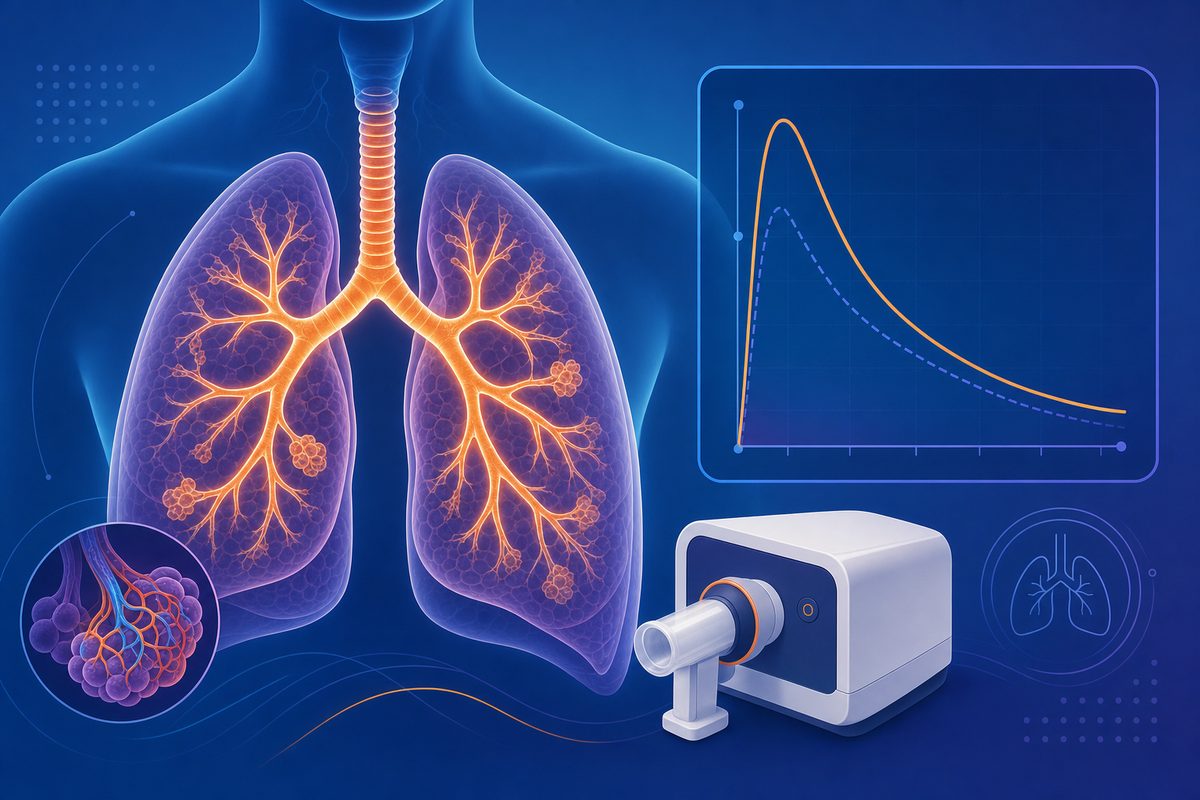
Pulmonology encompasses a wide range of services from routine office management of obstructive lung disease to complex inpatient critical care. The outpatient practice revolves around pulmonary function testing (PFT) and bronchoscopy as procedure-based revenue, alongside E/M-based chronic disease management for conditions including COPD (J44.x), asthma (J45.x), interstitial lung diseases (J84.x), pulmonary hypertension (I27.x), and lung malignancy (C34.x). PFTs—spirometry, diffusion capacity, lung volumes, and bronchodilator response testing—have technical and professional components that must be correctly coded based on what was performed and documented, with the physician's interpretation required for the professional component code.
Bronchoscopy is the highest-value procedure in pulmonology, with a complex family of CPT codes that must be selected based on the specific technique and findings. Flexible bronchoscopy with bronchoalveolar lavage (BAL), biopsy, brushings, and protected brush are each separately coded. Navigational bronchoscopy (robotic bronchoscopy, electromagnetic navigational bronchoscopy/ENB) uses specific CPT codes (31627 for navigational: CT guidance; 31628 for transbronchial biopsy with fluoroscopy). Cryobiopsy (32408) is increasingly used for ILD diagnosis. EBUS-TBNA (31652–31653) for mediastinal staging requires documentation of each lymph node station sampled. Bronchoscopy with bronchial thermoplasty for severe asthma (31660–31661) requires specific prior authorization and three separate treatment sessions.
Critical care (99291–99292) is a major revenue component for hospital-based and intensivist pulmonologists. Critical care billing is time-based—99291 covers the first 30–74 minutes of direct care, 99292 covers each additional 30 minutes. Documentation must reflect the physician's direct involvement in managing the critical illness and the total time spent. Critical care cannot be billed on the same day as a procedure with a separate global period unless the condition requiring critical care is completely distinct from the operative diagnosis. Mechanical ventilation management (94002–94004, 94660) adds separate billable services but has specific documentation requirements distinguishing initial from subsequent days of ventilator management.
Below are commonly billed codes our certified coders manage for pulmonology practices. Always confirm payer-specific coverage and current code values.
| Code | Description | Billing note |
|---|---|---|
94010 | Spirometry, including graphic record, total and timed vital capacity, expiratory flow rate measurement(s) | Most common PFT; global code when practice owns equipment and physician interprets; -26 modifier when interpretation only |
94060 | Spirometry, including graphic record, before and after bronchodilator administration | Bronchodilator response test; documents reversibility for asthma/COPD; frequently paired with 94010 in same session with -59 |
94726 | Plethysmography for determination of lung volumes and, when performed, airway resistance | Body box plethysmography; measures lung volumes (TLC, RV, FRC); higher RVU than spirometry; requires calibrated plethysmograph |
94729 | Diffusion capacity (DLCO) test (add-on) | Add-on code; always paired with 94010 or 94726 as primary; critical for ILD and pulmonary vascular disease workup |
31623 | Bronchoscopy, rigid or flexible; with brushing or protected brushings | Add-on or standalone bronchoscopy with brushings; document site and culture submission |
31624 | Bronchoscopy with bronchoalveolar lavage (BAL) | Therapeutic or diagnostic BAL; document volume instilled/returned and indication (infection, ILD workup) |
31652 | Bronchoscopy with transbronchial needle aspiration biopsy(ies), EBUS, first lobe/segment | EBUS-TBNA for mediastinal staging; 31653 add-on for each additional station sampled |
99291 | Critical care, evaluation and management; first 30–74 minutes | Time-based critical care; document total time; cannot be billed during post-op global period for surgical complications |
94002 | Ventilation assist and management, initiation of pressure or volume preset ventilators for assisted or controlled breathing; hospital inpatient/observation, initial day | Initial day of mechanical ventilation management; use 94003 for subsequent hospital days, 94004 for nursing facility |
Our standard operating procedures for pulmonology revenue cycle management — the step-by-step workflow we follow on every claim:
These are the issues we see most often in pulmonology billing — and exactly how we resolve them:
Pulmonologists interpreting PFTs performed at a hospital PFT lab must bill with modifier -26. Billing the global code when the practice does not own the equipment creates a duplicate claim conflict with the hospital's -TC billing. Fix: map each testing location to its billing modifier in your PM system and train staff that location determines modifier.
Billing advanced bronchoscopy codes (31652, 31627) without the procedure report explicitly documenting that the advanced technique (EBUS, navigation) was used results in audit denial. Fix: require the pulmonologist to sign and finalize the bronchoscopy report before claims are submitted; implement a report template that includes checkboxes for each technique performed.
Critical care claims denied when the note does not specify total direct patient contact time or fails to document the nature of the critical illness. Fix: implement a critical care documentation template that includes a mandatory 'Total physician time with patient today: ___ minutes' field and a critical illness summary.
Billing 94010 (spirometry), 94726 (plethysmography), and 94729 (DLCO) on the same date is appropriate only if all three were actually performed in the same session. Billing for tests not performed constitutes fraud. Fix: tie billing to the PFT report output—claims are generated from the test results, not pre-selected from a template.
Medicare pulmonary rehabilitation (G0424) requires specific qualifying diagnoses (COPD Gold Stage II–IV), a physician-ordered program, and attendance records. Claims denied when documentation is missing. Fix: implement a rehab enrollment checklist confirming qualifying diagnosis (with spirometry-confirmed GOLD classification), physician order, and session logs before billing.
Verimedix works inside the systems pulmonology practices already use, including:
Spirometry (94010 or 94060) is the primary code. Diffusion capacity (94729) is an add-on code that must be billed with a primary service code. Both can be performed in the same session. If plethysmography (94726) is also performed, it replaces spirometry as the primary code; 94729 remains an add-on.
No. You cannot bill both critical care (99291) and an E/M visit (99213–99215) for the same patient on the same day by the same provider. Critical care subsumes all E/M services for that date. If a separate problem is managed that is completely unrelated to the critical illness, document it separately and contact the payer—this is rarely payable.
Standard transbronchial biopsy uses CPT 31628. Cryobiopsy for suspected interstitial lung disease uses CPT 32408 (percutaneous or bronchoscopic biopsy of lung, cryobiopsy). EBUS-guided transbronchial biopsy uses 31652/31653. Document the specific technique, site, and number of specimens obtained.
Yes. Medicare covers bronchial thermoplasty for severe persistent asthma not controlled by medications. It requires three separate treatment sessions (right lower lobe, left lower lobe, both upper lobes). CPT 31660 covers the first bronchoscopy segment; 31661 is the add-on for each additional segment treated in the same session. Prior authorization is required by most commercial payers.
If a separately identifiable E/M was performed on the same day as the PFT (e.g., a new problem addressed or a significant clinical decision made beyond interpreting the test), bill the E/M with modifier -25 and the PFT separately. Routine review of PFT results as the primary purpose of the visit does not support a separate E/M.
Key diagnoses include: J44.1 (COPD with acute exacerbation), J44.0 (COPD with acute lower respiratory infection), J45.50 (severe persistent asthma, uncomplicated), J84.17 (RB-ILD), J84.112 (idiopathic pulmonary fibrosis), I27.0 (pulmonary arterial hypertension), C34.11–C34.92 (lung malignancy by site), and J93.11 (primary spontaneous pneumothorax). Specificity in COPD coding (GOLD stage, acute vs. stable) affects quality metrics and risk adjustment.
Verimedix handles the entire pulmonology revenue cycle — coding, submission, denials, and A/R — so your team can focus on patients.