
Sports medicine billing spans evaluation and management, joint injections, orthopedic procedures, imaging interpretation, and DME—each governed by different rules and frequent payer authorization requirements. VeriMedix brings the multi-code expertise sports medicine practices need to capture all billable services while staying compliant with NCCI edits, global period rules, and DME billing requirements.
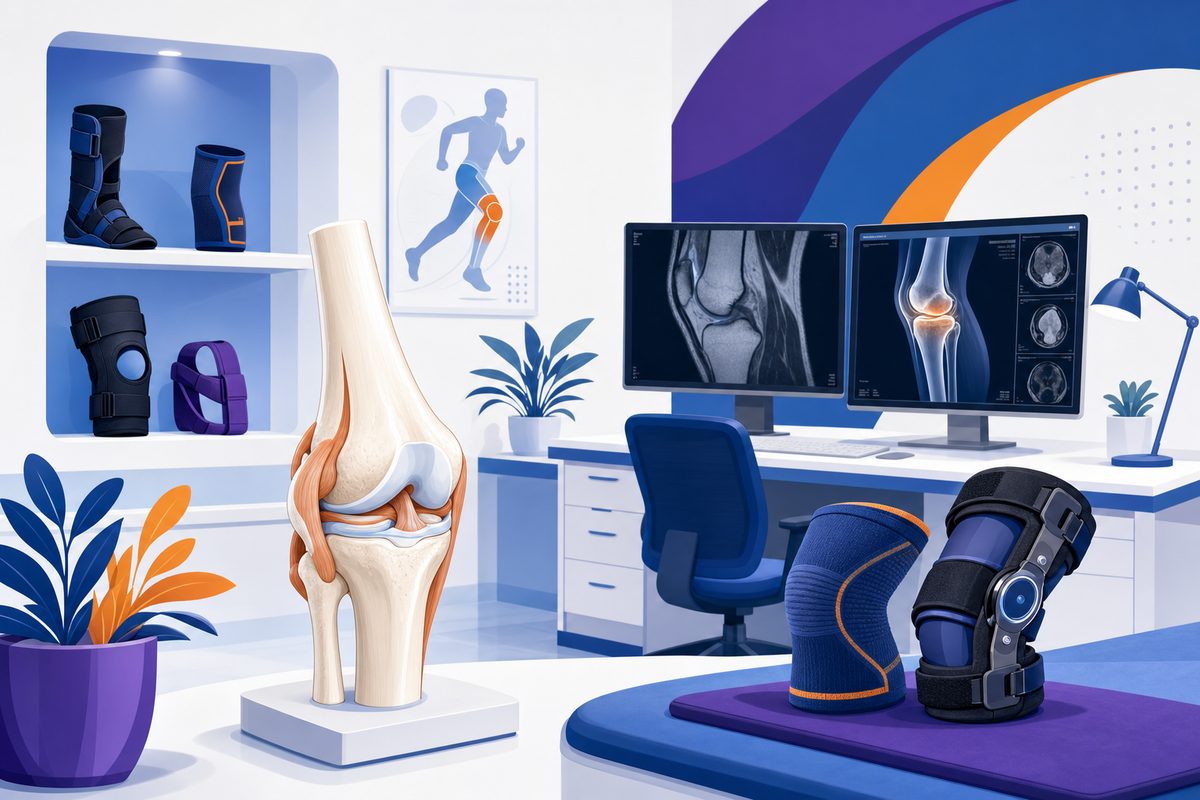
Sports medicine billing is characterized by its breadth: a single patient visit may generate an E/M charge, a joint injection, an ultrasound-guided aspiration, and a DME supply order—each requiring separate coding, proper modifier application, and frequently, prior authorization. The backbone of sports medicine coding is the E/M code set (99202–99215), with documentation requirements under the 2021 AMA medical decision-making or total-time framework. When a procedure such as a joint injection is performed on the same day as an E/M, modifier 25 must be appended to the E/M code to distinguish it as a separately identifiable evaluation; without modifier 25, the E/M will be denied as bundled into the procedure.
Joint injection and aspiration procedures are among the most frequently billed services in sports medicine. CPT 20610 covers aspiration/injection of a major joint (shoulder, hip, knee) without ultrasound guidance; 20611 is the same procedure with ultrasound guidance (which requires documented image storage and a report). Codes 20605/20606 cover intermediate joints (elbow, wrist, ankle), and 20600/20604 cover small joints (fingers, toes). When ultrasound guidance is used (20604, 20606, 20611), the imaging is bundled into the code—do not separately bill 76942. Drug costs (e.g., corticosteroids, viscosupplementation) are generally billed separately using HCPCS J-codes (J3301 for triamcinolone, J7321–J7328 for hyaluronic acid products), but verify payer-specific policies as some payers bundle drug costs into the injection fee.
Orthopedic procedures in sports medicine—arthroscopy, tendon repairs, fracture management—carry 90-day global periods during which post-operative visits, minor complications, and routine follow-up are not separately billable by the operating surgeon. DME billing (braces, crutches, orthotics) requires HCPCS codes, written physician orders, proof of medical necessity, and often prior authorization. Practices that dispense DME must comply with DMEPOS supplier enrollment rules and cannot bill for items they are not enrolled to supply. Imaging (X-ray, MRI, ultrasound) may be billed globally or split into TC and 26 components depending on equipment ownership and radiologist arrangements.
Below are commonly billed codes our certified coders manage for sports medicine practices. Always confirm payer-specific coverage and current code values.
| Code | Description | Billing note |
|---|---|---|
99213 | Office or other outpatient visit, established patient; low MDM or 20–29 minutes | Most common sports medicine E/M; append modifier 25 when a procedure is also performed same day |
20610 | Arthrocentesis, aspiration and/or injection, major joint or bursa (shoulder, hip, knee, subacromial); without ultrasound guidance | Bill one unit per joint per DOS; append RT or LT for laterality; modifier 50 for bilateral (e.g., bilateral knee injections) |
20611 | Arthrocentesis, aspiration and/or injection, major joint; with ultrasound guidance, with permanent recording and report | Requires documentation of image storage and written report; ultrasound bundled—do not separately bill 76942 |
20605 | Arthrocentesis, aspiration and/or injection, intermediate joint or bursa; without ultrasound guidance | Intermediate joints: elbow, wrist, temporomandibular, ankle; add modifier RT/LT for laterality |
20552 | Injection(s); single or multiple trigger point(s), 1 or 2 muscles | Distinguish from joint injection; document the specific muscles treated |
29827 | Arthroscopy, shoulder, surgical; with rotator cuff repair | 90-day global period; major surgical procedure; prior authorization required by most commercial payers |
73721 | MRI, any joint of lower extremity; without contrast | Bill globally if you own the scanner; modifier 26 if interpreting only; often requires prior authorization |
97110 | Therapeutic exercises; each 15 minutes | When PT services are provided in a sports medicine office setting; timed code subject to 8-minute rule |
E1399 | Durable medical equipment, miscellaneous (HCPCS) | Catch-all DME code; use only when no specific HCPCS code exists; document the specific item |
Our standard operating procedures for sports medicine revenue cycle management — the step-by-step workflow we follow on every claim:
These are the issues we see most often in sports medicine billing — and exactly how we resolve them:
Billing an E/M code and a joint injection on the same date without modifier 25 will result in the E/M being bundled into the procedure and denied. Fix: implement a claim scrubbing rule that auto-flags any combination of E/M + procedure codes on the same DOS without modifier 25; require providers to document a separately identifiable evaluation in the medical record.
CPT codes 20611, 20606, and 20604 already include ultrasound guidance. Billing 76942 alongside these codes triggers an NCCI bundling denial. Fix: add a hard billing edit preventing 76942 from being billed on the same date as 20611, 20606, or 20604 for the same patient.
MRIs, arthroscopic surgeries, and many joint injection series require prior authorization from commercial payers. Services rendered without authorization result in full denial with limited recourse. Fix: build a payer-by-procedure authorization matrix; require front-desk or care coordinator teams to obtain all authorizations before the service date, with documented confirmation numbers.
Routine follow-up visits and minor complications within 90 days of a major surgical procedure are included in the global surgical package and cannot be separately billed by the operating surgeon. Billing these visits generates claim denial and potential recoupment. Fix: flag surgical dates in the scheduling system to suppress E/M billing for related issues during the global period; use modifier 24 (unrelated E/M) with documentation only when the visit genuinely addresses a condition unrelated to the surgery.
Billing HCPCS equipment codes without a written order, proof of delivery, or without being enrolled as a DMEPOS supplier results in denial or recoupment. Fix: establish a DME intake checklist that confirms: written order on file, DMEPOS supplier enrollment active, delivery receipt obtained, prior authorization confirmed (if required), and medical necessity documented in the clinical note.
Verimedix works inside the systems sports medicine practices already use, including:
Yes, if injections were performed on different joints on the same day, each is billed separately with appropriate RT/LT or anatomic laterality modifiers and modifier 59 to identify the distinct nature of each service. Bill one unit per joint—not per injection site or per substance injected into the same joint. Document each joint treated, the clinical indication, and the medication/dose in the procedure note.
The procedure code (20610 or 20611) is the same regardless of the substance injected; the difference lies in the drug (J-code). Hyaluronic acid viscosupplementation products have their own J-codes (J7321–J7328 depending on the brand), and coverage varies by payer. Medicare covers some products for knee osteoarthritis with specific diagnostic criteria (M17.0–M17.12); prior authorization is often required. Document the medical necessity for viscosupplementation, including the patient's failed response to prior conservative treatment.
PRP injections do not have a specific CPT code. The injection procedure may be coded with the appropriate joint injection code (20610, 20605, etc.) if applicable, but the PRP product itself (preparation and injection) is coded with unlisted procedure codes such as 0232T (injection of platelet-rich plasma) or state-specific codes where applicable. Coverage by Medicare and most commercial payers is limited or absent, as PRP is typically considered investigational. Obtain an ABN from Medicare patients before providing PRP service.
Yes. E/M codes 99202–99215 are valued on the same RVU schedule regardless of the physician's specialty. The 2021 AMA documentation framework (medical decision-making or total time) applies to sports medicine E/M visits as it does to all office-based specialties. Practices should ensure providers are selecting the E/M level based on MDM complexity or total time documented, not defaulting to lower-level codes.
For HCPCS-coded braces (e.g., L1832 for functional knee orthosis), the medical record must include: a written physician order specifying the exact brace type and clinical indication; a diagnosis code supporting medical necessity; a functional assessment of the patient's mobility and limitations; and a delivery receipt signed by the patient. Many Medicare and commercial payers also require prior authorization for custom-fabricated orthoses. Off-the-shelf DME items require a detailed written order; custom items require detailed clinical justification.
Sports medicine physicians typically focus on non-surgical or minimally invasive management of musculoskeletal conditions—injections, rehabilitation, bracing, and concussion management—with less surgical volume than orthopedic surgeons. The billing mix skews toward E/M visits, joint injections, imaging, and DME rather than surgical procedures with global periods. Sports medicine practices may also bill for exercise testing, pre-participation physicals (billed as preventive E/M), and team physician services.
For injections: 20610 (major joint without US guidance) and 20611 (major joint with US guidance). For knee arthroscopy: 29881 (with meniscectomy), 29880 (with medial and lateral meniscectomy), 29877 (chondroplasty), 29870 (diagnostic). For shoulder arthroscopy: 29826 (with limited decompression), 29827 (with rotator cuff repair), 29823 (debridement). For tendon repairs: 27605/27606 for Achilles, 24357 for lateral epicondyle. Always confirm the specific procedure matches the billed code descriptor and operative report.
Verimedix handles the entire sports medicine revenue cycle — coding, submission, denials, and A/R — so your team can focus on patients.