
Thoracic surgery billing demands precise distinction between VATS (video-assisted) and open thoracic approaches, accurate global period management for major lung and esophageal resections, and mastery of complex multi-specialty coordination billing. VeriMedix delivers the coding accuracy and payer expertise that thoracic practices require to optimize revenue.
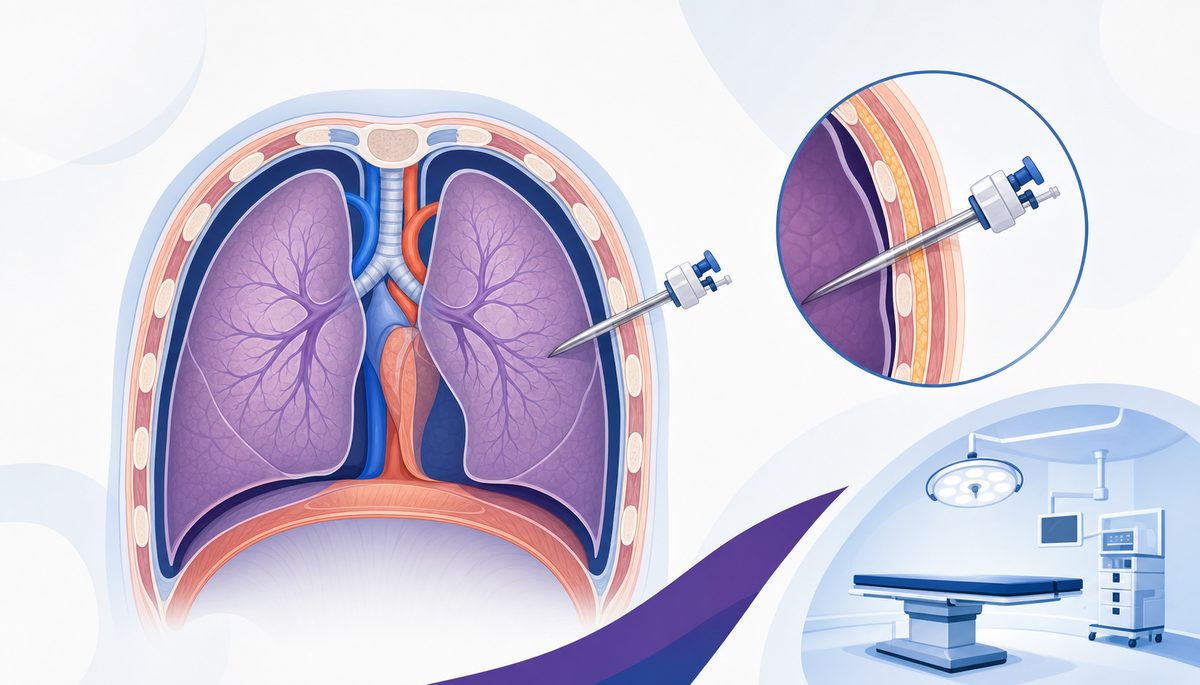
Thoracic surgery encompasses procedures on the lungs, esophagus, mediastinum, chest wall, diaphragm, and pleura—ranging from diagnostic bronchoscopy to complex pulmonary resections and esophagectomy. The most significant billing distinction is the surgical approach: video-assisted thoracic surgery (VATS) procedures have distinct CPT codes from open thoracotomy approaches, and the correct code must reflect the approach actually completed. For example, VATS lobectomy (32663) and open lobectomy (32480) are entirely different CPT codes with different RVU values. When a VATS procedure is converted to open thoracotomy intraoperatively, the surgeon must code the completed open procedure, not the originally intended VATS approach.
Most major thoracic surgical procedures carry a 90-day global period, meaning post-operative management, chest tube management, and routine follow-up are bundled. Thoracic surgeons frequently co-manage hospitalized patients with pulmonologists and intensivists (critical care), requiring careful coordination of who bills what during the post-operative period. Critical care billing (99291, 99292) is separately payable during the global period only when the critical care services are unrelated to the surgical procedure or the post-operative complications are so severe as to constitute a new clinical condition. Thoracic surgery also involves significant hospital and ICU-based billing (99221–99233 inpatient visits), which must be stratified correctly by complexity level.
Robotic-assisted thoracic surgery (RATS) uses the same CPT codes as the equivalent VATS procedures—there is no separate robotic CPT designation. Modifier -22 (increased procedural complexity) may be appropriate in cases of extraordinary complexity, but robotic technique alone does not justify -22. Payers do not pay separately for the robotic approach. Bronchoscopy (31622–31654) is frequently performed in conjunction with thoracic procedures or as a standalone diagnostic/therapeutic service, with its own coding family including bronchial thermoplasty, endobronchial ultrasound (EBUS: 31652, 31653), and transbronchial biopsy—all of which require accurate coding to capture full procedural value.
Below are commonly billed codes our certified coders manage for thoracic surgery practices. Always confirm payer-specific coverage and current code values.
| Code | Description | Billing note |
|---|---|---|
32663 | Thoracoscopy (VATS), surgical; with lobectomy | 90-day global; use when VATS approach completed; if converted to open, use 32480; requires documentation of approach |
32480 | Removal of lung, other than pneumonectomy; single lobe (lobectomy) | 90-day global; open thoracotomy approach; higher RVU than VATS for same anatomic procedure |
32503 | Resection of apical lung tumor (e.g., Pancoast); without chest wall resection | Complex procedure; 90-day global; frequently requires multi-specialty coordination |
32096 | Thoracotomy with diagnostic biopsy(ies) of lung infiltrate(s) | 90-day global; open biopsy; compare with VATS biopsy (32606) when approach is thoracoscopic |
31625 | Bronchoscopy, rigid or flexible, with bronchial or endobronchial biopsy(ies) | 0-day global; frequently performed with EBUS (31652) and staging procedures; document number and site of biopsies |
31652 | Bronchoscopy with transbronchial needle aspiration biopsy(ies), EBUS, first lobe/segment | EBUS-guided biopsy for mediastinal staging; add-on 31653 for each additional lobe/segment |
39401 | Mediastinoscopy; includes biopsy(ies) of mediastinal mass(es) | Diagnostic staging procedure for lung cancer; 0-day global; frequently precedes lobectomy |
43117 | Partial esophagectomy, distal two-thirds, with thoracotomy and separate abdominal incision | 90-day global; complex multi-stage procedure; multi-specialty billing if thoracic and general surgeons each perform a portion |
Our standard operating procedures for thoracic surgery revenue cycle management — the step-by-step workflow we follow on every claim:
These are the issues we see most often in thoracic surgery billing — and exactly how we resolve them:
Coding the VATS CPT (32663) when the operative report documents conversion to open thoracotomy (32480) results in underpayment and potential compliance risk. Fix: require coders to read the entire operative report, not just the operative header—conversion documentation is often in the body of the note, not the title.
Billing critical care (99291) during the 90-day global period for post-operative complications related to the surgery is not separately payable. Fix: establish a clear documentation standard requiring the critical care note to explicitly state whether the condition requiring critical care is related or unrelated to the procedure.
Practices performing EBUS bronchoscopy for mediastinal staging (31652, 31653) frequently only bill the basic bronchoscopy code (31625), missing add-on codes for additional sampled stations. Fix: implement an EBUS procedure note template that prompts documentation of each lymph node station sampled, supporting billing of 31653 for each additional station.
For esophagectomy or procedures with separate abdominal and thoracic phases performed by two surgeons, the incorrect application (or omission) of -62 leads to payment disputes. Fix: coordinate modifier usage between both surgical groups before claim submission; document each surgeon's distinct contribution in separate operative dictation.
Thoracic cancer patients often require a staging procedure (mediastinoscopy, EBUS) followed by a separate resection surgery; each requires its own authorization. Failure to obtain authorization for the resection after the staging procedure results in denial. Fix: implement a staging-to-resection authorization workflow with automatic follow-up triggers when staging findings indicate resection is planned.
Verimedix works inside the systems thoracic surgery practices already use, including:
Robotic-assisted thoracic procedures are coded with the same CPT codes as their VATS equivalents—there is no separate CPT for robotic surgery. The operative report should document the robotic approach. Modifier -22 is not appropriate solely because a robotic platform was used; it applies only when the overall complexity significantly exceeded standard.
Yes, if the bronchoscopy was a separate, distinct service with its own indication and documentation. Apply modifier -59 to the bronchoscopy code. NCCI edits should be reviewed to confirm the specific code pair is eligible for separate billing with -59.
Endobronchial ultrasound (EBUS) is a bronchoscopic technique for real-time ultrasound-guided needle biopsy of mediastinal and hilar lymph nodes. CPT 31652 covers the bronchoscopy with EBUS and transbronchial needle aspiration for the first lobe or segment; CPT 31653 is the add-on code for each additional lobe or segment sampled in the same session.
Bill the procedure actually performed—pneumonectomy (32440 for open, or appropriate VATS equivalent). The pre-operative plan does not determine the CPT code; the completed procedure does. Document the reason for conversion in the operative report.
Common diagnoses include: C34.10–C34.92 (malignant neoplasm of bronchus/lung by site), C38.0–C38.4 (malignant neoplasm of heart/mediastinum/pleura), J93.11 (primary spontaneous pneumothorax), J86.0 (pyothorax with fistula), K22.10 (ulcerative esophagitis), and Z12.11 (lung cancer screening encounter) for low-dose CT screening.
Low-dose CT lung cancer screening uses CPT 71271 (CT thorax, low dose, for lung cancer screening). The ICD-10 code Z12.11 (encounter for screening for malignant neoplasm of lung) and Z87.891 (history of tobacco use) are common associated diagnoses. Medicare covers this as a preventive benefit for qualifying beneficiaries aged 50–80 with a 20 pack-year smoking history.
Verimedix handles the entire thoracic surgery revenue cycle — coding, submission, denials, and A/R — so your team can focus on patients.