
Gastroenterology billing is driven by high-volume endoscopy procedures with complex family code hierarchies, critical screening-to-diagnostic conversion rules, and bundling edits that require precise code selection to avoid systematic underpayment. VeriMedix brings the GI-specific coding expertise to maximize reimbursement while keeping every claim defensible.
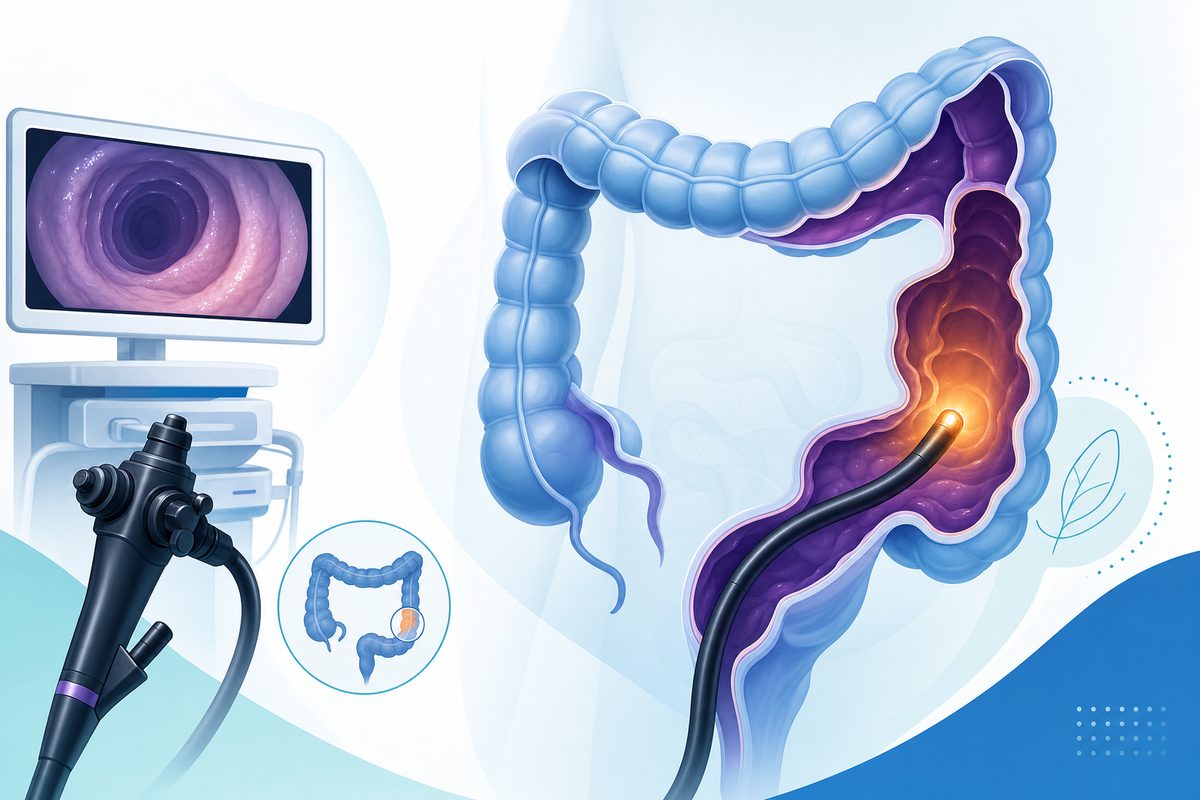
Gastroenterology practice revenue is largely procedure-based, centered on upper GI endoscopy (EGD, 43235–43259) and lower GI endoscopy (colonoscopy, 45378–45398; flexible sigmoidoscopy, 45330–45347) families. These CPT families are structured hierarchically: the base code (e.g., 45378 for diagnostic colonoscopy) represents the minimum service, while add-on codes or higher-level codes represent additional interventions (polypectomy, biopsy, dilation, ablation) performed during the same session. The AMA and CMS both specify that only the single most complex procedure in a family should be billed per anatomic region per session—you do not bill 45378 plus 45380 (biopsy); you bill only the biopsy code (45380) or the more complex code if multiple interventions were done.
Screening colonoscopy creates the most complex billing scenario in GI: when a screening colonoscopy (Z12.11 or Z80.0 for family history of colorectal cancer) encounters a polyp and becomes a diagnostic/therapeutic procedure, the appropriate CPT shifts to a polypectomy or biopsy code, but the screening intent must be preserved with modifier -33 (preventive service) for Medicare and most commercial payers to ensure the patient does not owe cost-sharing. Without modifier -33, the patient's cost-sharing liability converts from $0 (preventive) to the standard deductible and coinsurance for a diagnostic procedure—a significant patient billing complaint and a compliance and patient satisfaction risk. The ICD-10 coding must transition from Z12.11 (screening encounter) to Z12.11 plus the finding code (e.g., K63.5 polyp of colon).
The professional/technical component structure in GI applies to practices that own their own endoscopy suite. In a hospital-based or HOPD endoscopy suite, the GI physician bills only the professional component of the procedure (modifier -26 is typically not required for surgical procedures—it applies to diagnostic imaging interpretation—but facility vs. non-facility fee schedules apply). The non-facility rate (when the physician owns the endoscopy suite) is significantly higher than the facility rate, making ambulatory endoscopy center ownership a major strategic revenue decision. Anesthesia for GI procedures (propofol/MAC sedation) is a separate billing stream from the GI procedure itself and is not included in the endoscopy code.
Below are commonly billed codes our certified coders manage for gastroenterology practices. Always confirm payer-specific coverage and current code values.
| Code | Description | Billing note |
|---|---|---|
45378 | Colonoscopy, flexible; diagnostic, with or without collection of specimen(s) by brushing or washing, with or without colon decompression | Base diagnostic colonoscopy code; do NOT bill when polypectomy or biopsy was performed—use the appropriate intervention code instead |
45380 | Colonoscopy, flexible; with biopsy, single or multiple | Use when biopsy only (cold forceps or hot); do not separately bill 45378 on same session |
45385 | Colonoscopy, flexible; with removal of tumor(s), polyp(s), or other lesion(s) by snare technique | Snare polypectomy; most common therapeutic colonoscopy code; does not separately bill 45378 or 45380 |
45384 | Colonoscopy, flexible; with removal of tumor(s), polyp(s), or other lesion(s) by hot biopsy forceps | Distinct from 45380 (cold biopsy); and 45385 (snare); select based on removal technique used |
43239 | Esophagogastroduodenoscopy (EGD); with biopsy, single or multiple | Most common EGD code; documents biopsy taken (e.g., for H. pylori, Barrett's, esophagitis); do not bill 43235 separately |
43254 | EGD with endoscopic mucosal resection (EMR) | High-value EGD; requires documentation of technique and lesion size/location; prior auth typically required |
45388 | Colonoscopy, flexible; with ablation of tumor(s), polyp(s), or other lesion(s) (thermal, bipolar, or cold coagulation) | Ablation technique; distinct from snare polypectomy; document technique and lesion type |
43262 | Endoscopic retrograde cholangiopancreatography (ERCP); with sphincterotomy/papillotomy | High-complexity ERCP; requires hospital or advanced GI center; multiple add-on codes for stent/stone extraction |
44388 | Colonoscopy through stoma; with biopsy, single or multiple | Colonoscopy via colostomy or ileostomy; different code family from standard colonoscopy; document approach clearly |
Our standard operating procedures for gastroenterology revenue cycle management — the step-by-step workflow we follow on every claim:
These are the issues we see most often in gastroenterology billing — and exactly how we resolve them:
Billing 45378 (diagnostic colonoscopy) in addition to 45380 (biopsy) or 45385 (polypectomy) on the same session violates CPT coding guidelines—the intervention code is inclusive of the base scope. Fix: train coders that only one colonoscopy code is billed per anatomic region per session; the most complex intervention code defines the service.
When a screening colonoscopy becomes therapeutic (polyp found and removed), failing to append -33 (or -PT for Medicare) causes the payer to reprocess as diagnostic, triggering patient cost-sharing that should be waived. This drives patient complaints and billing disputes. Fix: implement an automatic workflow: whenever CPT changes from 45378 to 45380/45385/45384 and the indication was screening, -33/-PT is required.
Using 45385 (snare) when the operative report documents hot biopsy forceps removal (45384) or cold forceps biopsy (45380) misrepresents the service. Fix: require proceduralists to specify removal technique in their endoscopy report using a structured template that maps to the correct CPT.
ERCP procedures frequently involve multiple components (sphincterotomy + stone extraction + stent placement), each with separate add-on codes (43262 + 43264 + 43274). Only billing the primary ERCP code significantly underpays the case. Fix: implement an ERCP coding checklist requiring the coder to account for every therapeutic maneuver documented in the procedure report.
Billing the non-facility (higher) fee schedule rate for a GI procedure performed at a hospital HOPD results in overpayment and recoupment. Fix: configure your PM system to auto-assign the correct fee schedule based on the location POS code at claim creation; audit quarterly for POS-to-fee-schedule mismatches.
Verimedix works inside the systems gastroenterology practices already use, including:
Modifier -33 tells the payer that the service is preventive in nature, even if a therapeutic intervention was performed during the same session. For Medicare and most ACA-compliant commercial plans, preventive colonoscopy is covered at 100% with no patient cost-sharing. Without -33 on a polypectomy, the payer reclassifies the claim as diagnostic, and the patient owes their deductible and coinsurance—often without warning.
Yes. When both an upper and lower GI endoscopy are medically necessary and performed on the same day, both may be billed. Apply modifier -59 to the second procedure to indicate distinct, separately reportable services. Documentation must support the independent medical necessity of each procedure.
When a colonoscopy is unable to reach the cecum, use modifier -52 (reduced services) on the appropriate colonoscopy code and document the reason for incomplete examination. For a completely aborted procedure before significant progress, -53 may be more appropriate. Document the prep quality, the extent of examination, and the clinical decision in the procedure note.
Radiofrequency ablation (RFA) of Barrett's esophagus is billed with CPT 43229 (EGD with ablation of tumor(s), polyp(s), or other lesion(s)). Prior authorization is required by most payers and requires documentation of Barrett's esophagus diagnosis (K22.70–K22.71), prior biopsy results confirming dysplasia grade, and a treatment plan.
No. Medicare covers screening colonoscopy (Z12.11) every 10 years for average-risk beneficiaries with no cost-sharing. Surveillance colonoscopy (Z86.010, personal history of colonic polyps) is covered at different frequencies based on pathology findings (typically every 3 or 5 years), and may apply deductible/coinsurance. Modifier -33 does NOT apply to surveillance—only to screening-to-therapeutic conversions.
Capsule endoscopy for the small intestine is billed with CPT 91110 (gastrointestinal tract imaging via pill camera; esophagus through ileum) or 91111 (esophageal capsule endoscopy). The professional component (reading) is included in 91110/91111 when the gastroenterologist performs both the capsule placement/setup and the interpretation. Requires documentation of medical necessity; commonly ordered for occult GI bleeding or Crohn's disease evaluation.
Verimedix handles the entire gastroenterology revenue cycle — coding, submission, denials, and A/R — so your team can focus on patients.